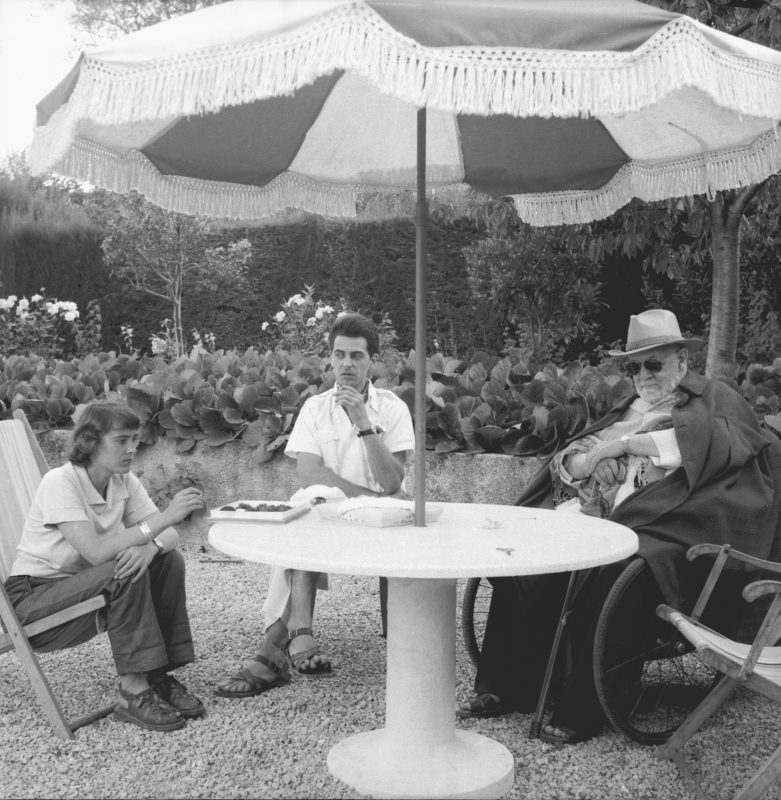
One summer’s day in 1943, Annelies Nelck (1925, Nice – 2014, Nexon), a young artist trying to earn a living, opened the door of Villa Le Rêve in Vence, where Matisse had just moved in. The latter then invited her to pose for him. From 1943 to 1946, she was the subject of many drawn portraits. In a book published in 1995, L’Olivier du rêve, Annelies Nelck gives a magnificent account of daily life at Villa Le Rêve in Vence, describing the painter’s routine, the simple joys and torments specific to these dark hours in the history of France. An artist herself, her story is coupled with a power of analysis that reflects a deep knowledge and understanding of the artist’s working methods.
He was no longer a God-the-Father in my eyes, but rather a reassuring and familiar grandfather, with whom I felt really confident. This is how the attitude of the body in harmony with the spirit presented itself, and naturally so.
Annelies Nelck, L’Olivier du rêve, p. 18
Of Dutch origin, Annelies Nelck left to study fine art in Amsterdam in 1938 before returning to live with her parents in 1943 near Vence. Trying to earn a living by making woodcuts but not finding the necessary material, she decided to take advice from an artist whose name was unknown to her at the time: Henri Matisse. She lived precariously after giving birth to a little boy whose father she would never see again, who died in the Netherlands where he had stayed to help the Resistance. These tragic ordeals undoubtedly resonated for the artist, who himself lived in anguish after the arrest in spring 1944 of his wife and daughter, both members of resistance organisations.
From summer 1943 until 1946, Matisse hired Annelies to pose and entrusted her with small jobs (sorting, once a month under his direction, the drawings, destruction of bad ones, tracings, fixing of charcoal drawings, tracings, etc). Beyond these functions, Annelies also had the opportunity to extend her artistic training with Matisse, who agreed to correct her drawings and provide her with advice.
With the trees, I approached, without realising it but with great strides, the problems of composition I had already sensed when seeing Matisse paint or draw. He drew my attention to how roots come out of the ground in nature… and in my drawings they came out… of nothing at all. But since he didn’t give me the solution to fix it, I racked my brains for a while – until I managed to get under the skin of the tree that had pierced the earth and continued to cling to it throughout its life to support and nourish its branches.
Annelies Nelck, L’Olivier du rêve, p. 64
From this education, she drew the confidence she needed to continue in her artistic direction under the name of Anatole. Married at the end of the 1940s to the artist Jean Vincent de Crozals, who posed for the Christ in the Chapelle de Vence, she became part of the artistic landscape of Vence, exhibiting several times at the gallery of Auguste Chave. In the 1970s, she produced mosaics and a mural in schools and a Post Office agency in the region. Besides Matisse, she frequented Henri Laurens and Jean Dubuffet, and worked with Marc Chagall. The couple also took part in church restoration projects, such as that of Vénaco (Corsica), where she reused plates of pink gold glass not used for the Chapelle de Vence, given to her by Matisse.
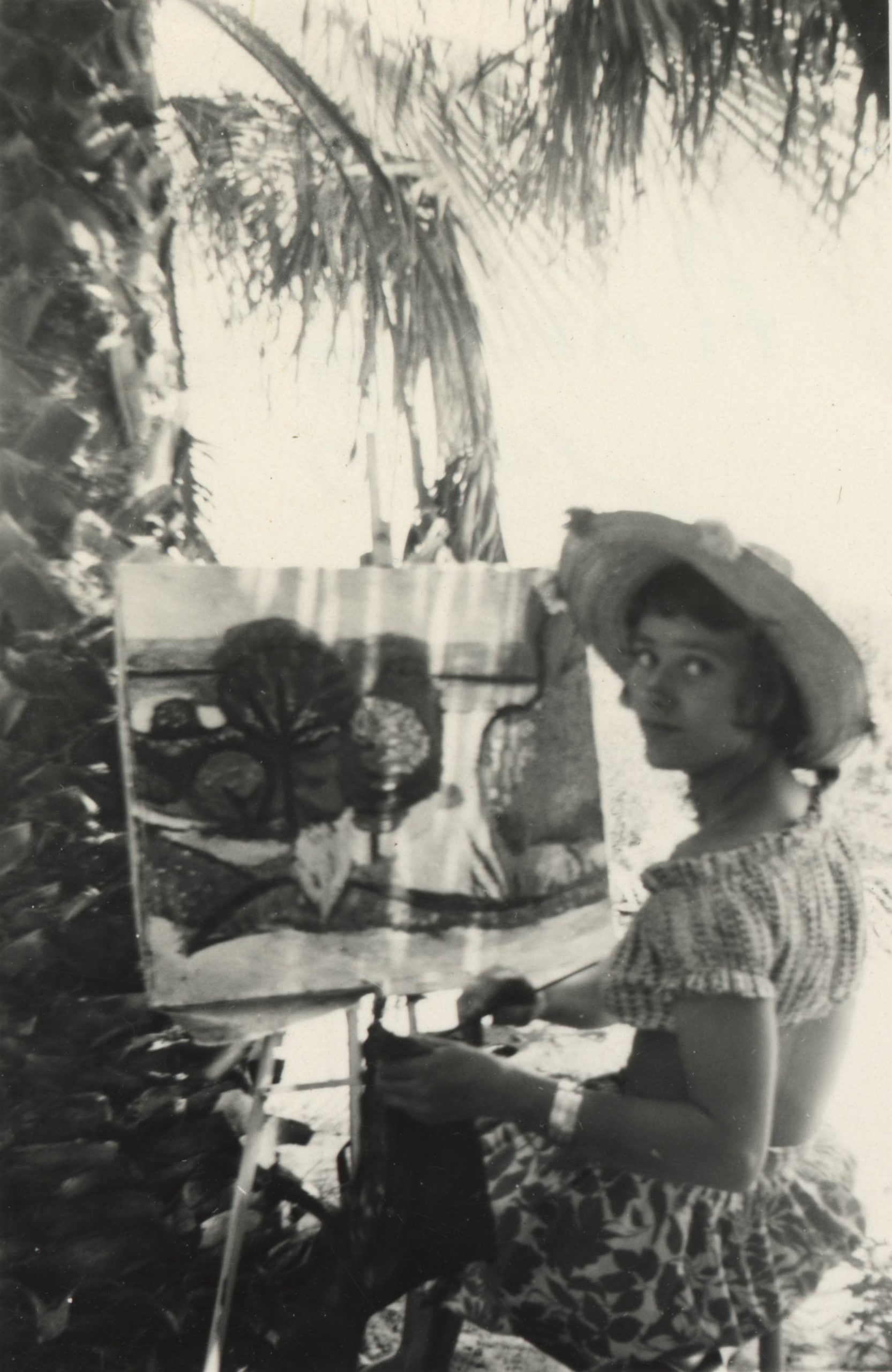
Photo: Archives Henri Matisse
Annelies in the works of Matisse
© Succession H. Matisse | Photo © François Fernandez
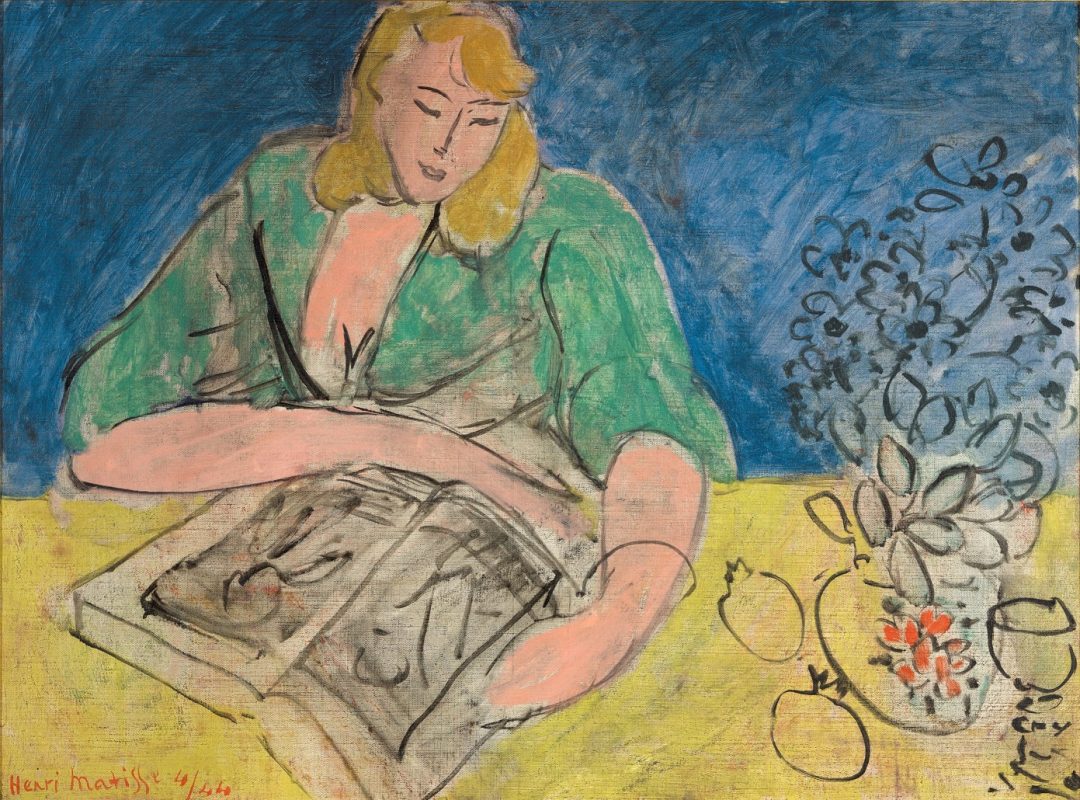
Annelies Nelck stands out from the constellation of models who, in the 1940s, fed a veritable artistic drive in Matisse and seems to have particularly crystallised his questioning about portraiture and the challenges it poses: transient expressions, the mysteries of inner character, the arrangement of the volumes that make up a face. Above all, she occupied an interesting place in the evolution of Matisse’s work, present throughout a time of transition in his practice. She is directly associated with the plural 1940s, marked by a distancing from painting (even though she was still the subject of three paintings, including Lectrice à la table jaune, kept at the Matisse Museum in Nice), a drawing frenzy and the implementation of a total art merging architecture and decoration. She posed for a decorative project – a door commissioned by the Anchoréna couple – and was commissioned by Matisse to create, with her companion, the holy water font for the Chapelle de Vence, whose design she followed closely.
Annelies through a work from the collection:
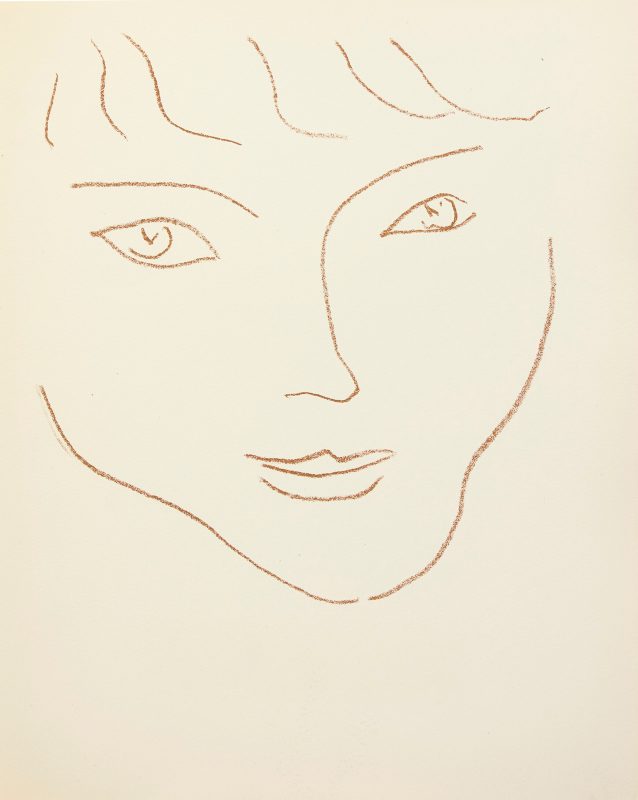
the illustrated book Visages, 1946
During the war, the illustrated book was the easiest way for Matisse to distribute his work. It was also an opportunity to spare himself the suffering caused by the pictorial impasse which confronted him. The book was also an ideal support for carrying out his experiments on the portrait and its serialisation, its format being perfectly suited to the deployment of individualised faces on the page and yet plural.
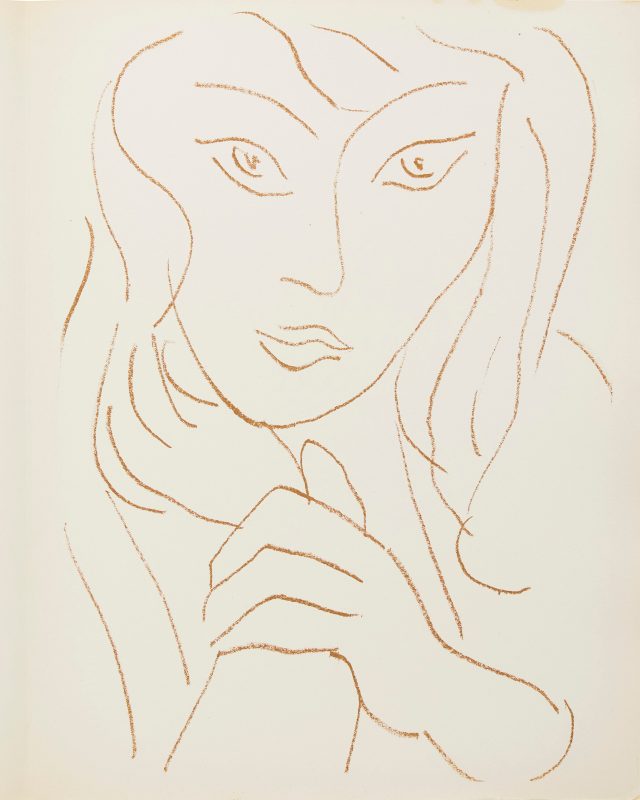
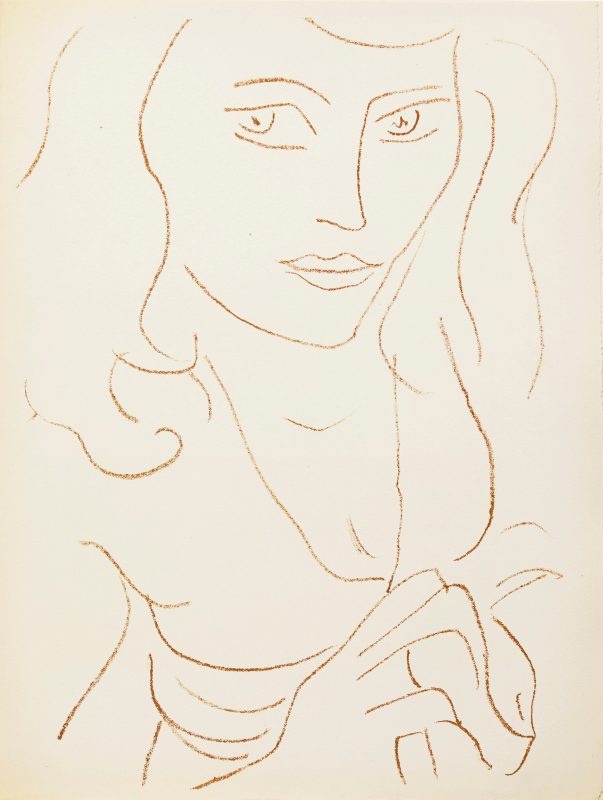
Annelies Nelck was the model for the fourteen lithographs illustrating Pierre Reverdy’s poetry collection, Visages. The forceful emergence of her face-mask which stands out on the first page with all the more sharpness while the ears, neck and hair have disappeared, is what surprises first. The few hatchings in the fringe, at the top of the sheet, breathe a slight movement into this minimal form, making it spill out of the page, suggesting that the hair is spreading beyond the paper. Annelies is reduced to the anonymity of an extreme graphic schematisation. Twelve lithographs “further”, her bust can be made out in a slight “view” from above. This unique framing gives flesh to her presence and engages a more direct conversation with the reader. Her physiognomy is a little more detailed, even if a simplifying principle still prevails. In addition to her face, it is the knot of her crossed fingers, an anatomical strangeness as if enlarged under a magnifying glass, which catches the eye.
There isn’t necessarily a linear or narrative progression to be sought in this sequence, rather the repeated observation of the inconsistencies of memory. On the surface of Reverdy’s poems emerge anonymous faces or their memory, the poet almost systematically returning to the difficulty of identifying, visualising, grasping the other.
Gift of Héritiers Matisse, 1960, Musée Matisse Nice
© Succession H. Matisse | Photos © D.R.