

© Succession H. Matisse | Photo © François Fernandez
In July 1943, Henri Matisse left Nice to escape the threat of bombardment and moved to Vence in the Villa Le Rêve where he stayed until 1948.
Dominican nuns ran a nursing home just across the street. His former night nurse and model Monique Bourgeois was convalescing there. He had hired her for a few months in 1942 as he was recovering from major surgery. They became friends and she started posing for him. Fate brought them together again in 1943. They rekindled their friendship and Monique continued to pose for him. In 1944 she took the veil and joined the Dominican community, becoming Sister Jacques-Marie.
I started with the secular and now in the evening of my life, I naturally end with the divine.
Henri Matisse, quoted by Monsignor Rémond, in L’Art sacré, July-August 1951
In 1947, the nuns were in desperate need of a chapel and Sister Jacques showed Matisse sketches she had made for a stained-glass window. On December 4, 1947, Brother Louis-Bertrand Rayssiguier who was passionate about modern art and convinced of its positive impact on religious art came to visit Matisse. He persuaded him not only to decorate but also design the entire chapel which would prove the synthesis of his past experimentations and research.
Helped by Father Marie-Alain Couturier and in collaboration with the architect August Perret and the master glazier Paul Bony, Henri Matisse started working on the project after returning to the Regina in 1949. He gradually turned his vast flat in a studio on the walls of which he displayed his maquettes, most of which were life-sized.

© Succession H. Matisse | Photo © François Fernandez
The first stone was laid on December 12, 1949 by Monsignor Rémond, Bishop of Nice, who consecrated it on June 25, 1951. Matisse was too tired to attend the inauguration and asked him to read a letter:
« This work has taken me four years of exclusive and diligent work, and it is the result of my entire working life. Despite all its imperfections I consider it to be my masterpiece. »

© Succession H. Matisse pour les œuvres de l’artiste
Photo © François Fernandez
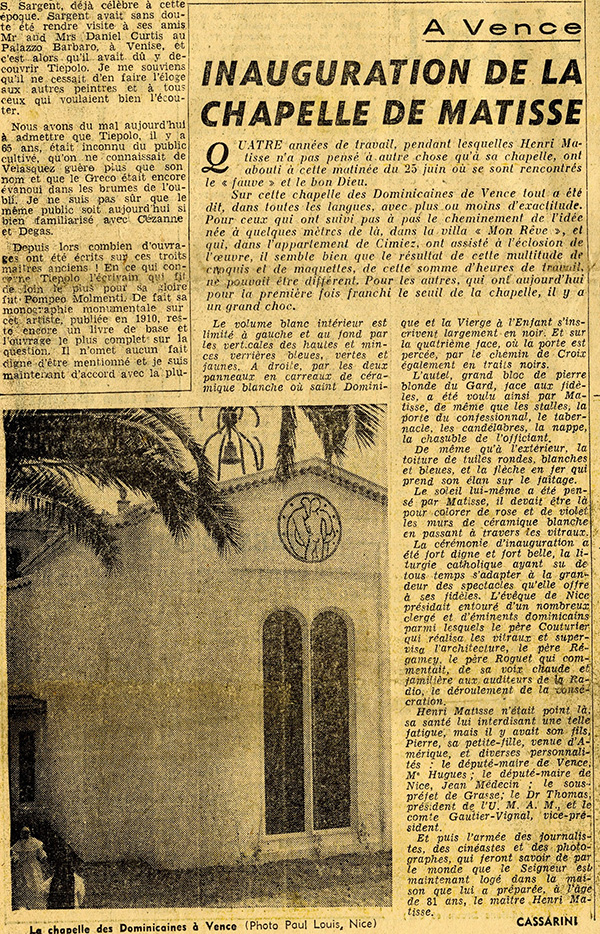
Centre de documentation du Musée Matisse
© Droits réservés
The Matisse Museum in Nice has important works linked with the Vence Chapel: 13 maquettes for chasubles and vestments, 3 maquettes for the chapel, 2 studies for La Jérusalem céleste stained glass window and a maquette for Les Abeilles, 2 large drawings representing St. Dominic.

Letter to Monsignor Rémond, Bishop of Nice
Centre de documentation du Musée Matisse
© Droits réservés

Letter to Monsignor Rémond, Bishop of Nice
Centre de documentation du Musée Matisse
© Droits réservés