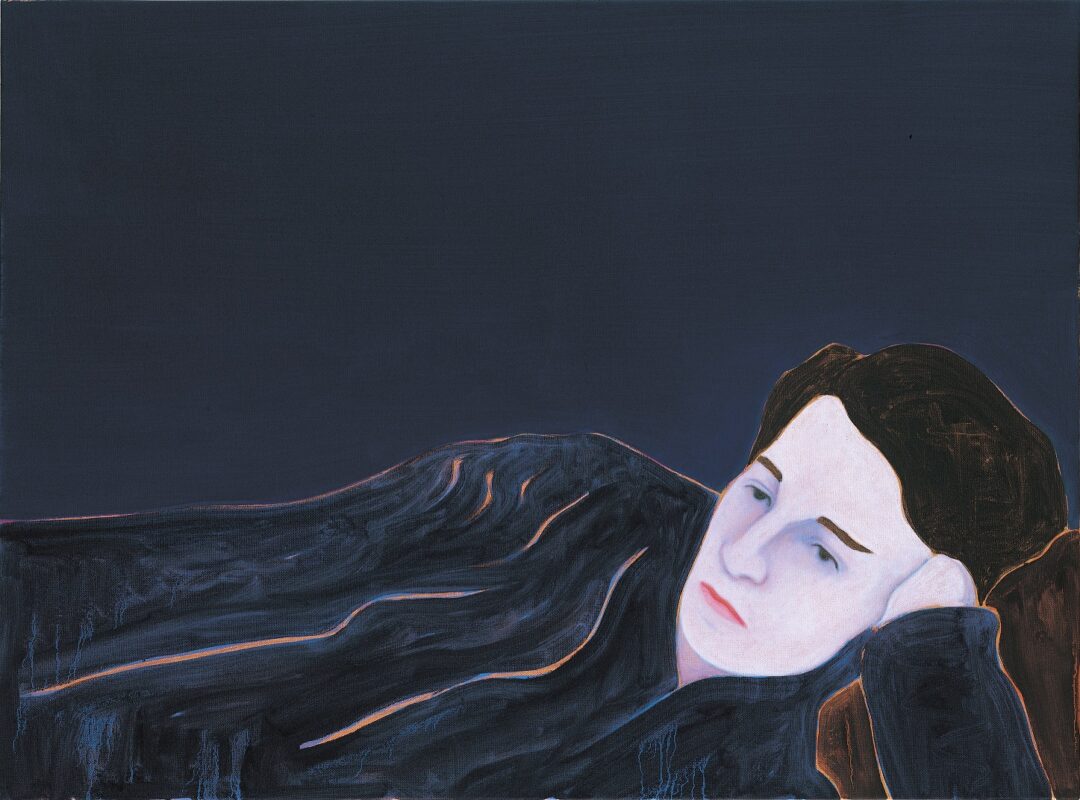
Djamel Tatah, Sans titre, 2009, huile et cire sur toile, 60 x 80 cm, coll. part., Paris
© Adagp, Paris, 2024 | Photo © Jean-Louis Losi
Curated by:
Éric de Chassey, Managing Director of the National Institute of Art History
In spring 2024, the Matisse Museum in Nice is offering an updated display of its collection, involving the painter Djamel Tatah (born 1959 in Saint-Chamond) and exhibition curator Éric de Chassey. They selected around a hundred graphic works and sculptures by Henri Matisse (1869-1954), spanning his entire career, from the museum’s collections, supplemented by exceptional loans from the National Institute of Art History (INHA). They will alternate with around thirty large-format paintings by Tatah, chosen from his production over the last twenty years and belonging to public as well as private collections.
It isn’t Matisse the colourist they decided to focus on, but the master of black and white, the artist of stroke and line, working obsessively on the same motifs, tirelessly studying gestures and their variations. In particular, these aspects will be put forward in groups of drawings made for “The Dance” commissioned by Albert Barnes (1930-1933), and for the Chapel of Notre-Dame du Rosaire in Vence (1948-1953), of sculptures of heads and seated women, as well as two series of lithographs from 1913 and etchings from 1929, borrowed from INHA and rarely exhibited in their entirety. These works by Matisse will interact in a series of consonances and dissonances with those of Tatah, which are based on the presence on a real scale of human figures, alone or in groups, performing precise choreographies against backgrounds of flat fields of colour. Direct confrontations between the two artists will be limited to a few situations, with most rooms devoted separately and alternatingly to each of them.
At the heart of the museum, a section will be devoted to what Tatah calls a “cabinet of common curiosities”. In it, he will place some of the objects Matisse surrounded himself with throughout his life, often from the Islamic world, and will mix them with some significant items from his own journey, from one shore of the Mediterranean to the other.