The destiny of Russian painter Olga Meerson (1880?, Moscow – 1930, Berlin), tainted by the tragedy of her suicide in 1930, has its dark side, unspoken words and depression. A few minute traces – the presence, in particular, of her name in exhibitions in Russia, France and Germany in the 1910s and 1920s and her works in the collections of the National Museum in Warsaw and the Lenbachhaus Museum in Munich – provide only partial information on her biography. By taking an interest in her, art historians inevitably come across secret aspects of the life of Henri Matisse, with whom she was in love. Without reducing Olga Meerson to her supposed affair with the painter, on which several Matisse specialists have agreed since the 1990s, we must not overlook the complex, tumultuous relationships that developed between them and which had undeniable consequences for both of them.
Miss Meerson is a true artist, and an artist who has something to say, but unlike some artists who have nothing to say and know how to say it pleasantly, she finds it very difficult to express clearly and purely the aspirations of her soul which are most noble. This is what caused her to voluntarily decide to leave the Painting profession as it is officially accepted, a profession made for everyone, to make it her own, allowing her to put across her emotions.
Henri Matisse, Letter to Dr Dubois, 28 November 1911
A resolute, gifted young woman, Olga was 31 when she asked Henri Matisse if she could continue her education at the academy he opened in January 1908, first installed in his studio on Rue de Sèvres, then in the Sacré-Cœur convent (current Rodin Museum). She was already trained, excelled in the art of portraiture and had built up a network of artistic friendships.
Coming from a wealthy, cultured Jewish family, she joined the Moscow School of Art at the age of 13, a feat whose precocity was undoubtedly commensurate with the talent of a brilliant, strong personality. Eight years later, she left Russia for Munich, where she became close to the group of artists united around Wassily Kandinsky, the Phalanx, as evidenced by several photographs by Gabriele Münter (here and here) or taken anonymously (here).
Olga moved again in 1905 and settled in Paris, where she was exhibited in 1906 at the Salon d’Automne. She lived a meagre life from copies of the masters and, dissatisfied with what she considered her over-conventional pictorial production, wanted to take on the principles Matisse instilled in his students. So she contacted him to attend his classes. He accepted and she, like Marie Vassilieff, moved into a room in the Sacré-Cœur convent.
Accompanying the Matisse family during a summer stay in Collioure in 1911, she witnessed the creation of major works, such as Intérieur aux aubergines (1911, Musée de Grenoble), confirming that she was, during this period, witness to important artistic explorations for the painter.
However, tragedy erupted when, at the beginning of 1912, Amélie Matisse took stock of the young woman’s love for her husband. Already psychologically weakened by what she considered to be her artistic failure and Matisse’s attitude, Olga, who had been taking drugs for several months, was hospitalised in Switzerland. They would never see each other again.
She left France for Munich, where in 1913 she married a musician, Heinz Pringsheim, brother-in-law of writer Thomas Mann. For the occasion, Matisse offered her a Corsica landscape, which she kept all her life. Olga Meerson committed suicide in Berlin on 26 June 1930. Many years later, having learned of her death, Matisse spoke with emotion of the “magnificent Russian Jewish woman” who had loved him so much.

Olga Meerson is the woman sitting in the centre in profile.
Photo : Archives Henri Matisse
Dear Sir,
Olga Meerson, postcard sent to M. Stein for Henri Matisse, 21 mars 1908
I send you my fondest memories of Moscow. I had the great pleasure of admiring your works here at Mrs Tchoukine [sic] and Morosoff [sic]. I hope to see you again soon in Paris. Please accept, Sir, my most sincere compliments.

From left to right: Olga Merson, Étienne Terrus, Amélie Matisse, Henri Matisse, Hans Purrmann, Marguerite Matisse
Musée Terrus archives, Elne. Photo: D.R.
Olga in the work of Matisse (and vice versa)

© Succession H. Matisse | Photo © The Museum of Fine Arts, Houston; Will Michels
Olga was involved with Henri Matisse during decisive years for the artist, who experimented to free himself from the risk of a rigidifying Fauvism while refusing to give in to the solutions offered by Cubism. She was also the subject of one of his strangest portraits (Olga Meerson, 1911, The Museum of Fine Arts, Houston), painted in the summer of 1911 in Collioure. He drew two black curves – a brutal addition without anatomical justification – on the body of Olga seated. These lines, with their enigmatic function – would this kind of framework aim to support the pose of the young woman already stiffly silent, or did it add movement to the composition? – bluntly cross her two hands placed one on the other, nestled with composure in the hollow of her thighs. Matisse left apparent the numerous reworkings of a silhouette which lost its scale during the making of the painting. The traces of the successive repositioning of her limbs create a blurring effect, almost making Olga’s body vibrate, more slender than originally. Her face isn’t spared, either, its left side seeming to be blurred.
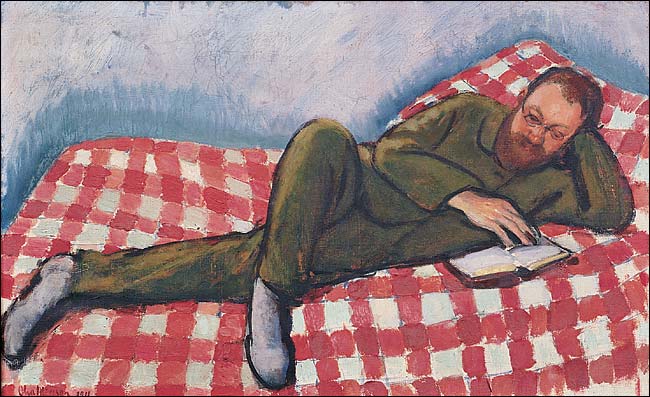
Olga was behind the most personal portrait that exists of Matisse, painted during the same stay in Collioure. Of the two portraits she made of him that summer, only the one in which we see him nonchalantly lying on the bed in his studio, reading, remains. Of the second portrait, exhibited at the Salon d’Automne, we have this remark by Apollinaire:
A very lifelike portrait of Henri Matisse by Mrs Meerson gives this set [the room dedicated to representatives of Fauvism] the meaning of a tribute to the leader of powerful, mellow colours.
Apollinaire, L’Intransigeant, 12 octobre 1911
While it remains difficult to establish the truth about the nature of the relationship between the two painters, a certain emotion and intimacy emerge in these reciprocal portraits.
Olga through a work from the collection:
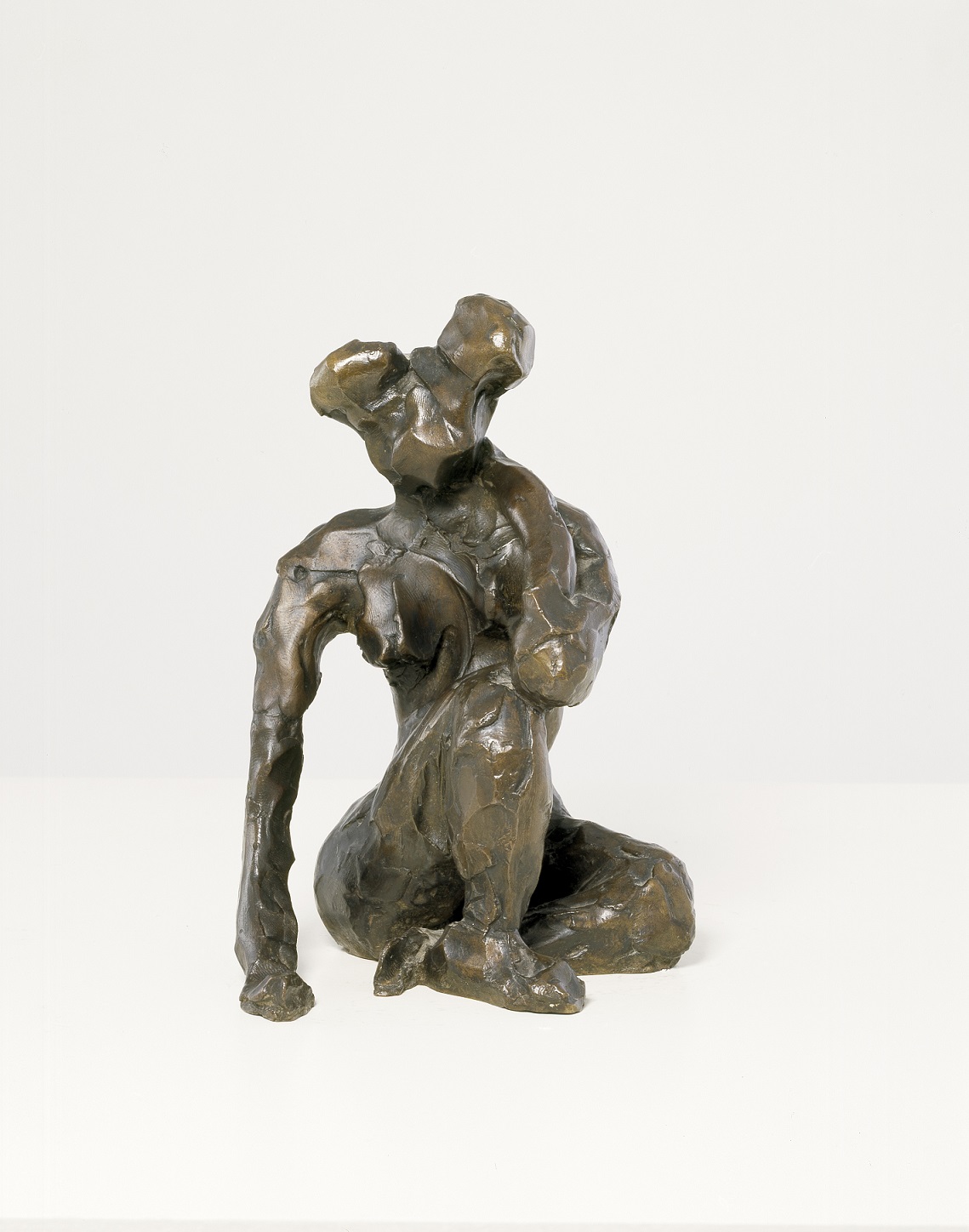
Nu accroupi, main droite à terre, 1908
In her biography of Henri Matisse, Hilary Spurling notes that “apart from Amélie and the occasional professional model, Olga was the only woman reckless enought to pose nude for Matisse in the years before the First World War” (Hilary Spurling, Matisse. The Master. A Life of Henri Matisse: The Conquest of Colour, 1909-1954, Hamish Hamilton, 2005). She didn’t hesitate to undress for the sculpture Grand Nu accroupi (Olga) (1909-1910, Kunsthaus Zürich), of which the small bronze Nu accroupi, main droite à terre, kept at the Matisse Museum, seems to have been one of the sketches. While for the latter, Matisse had recourse to a photograph, it was based on Olga that he sculpted his Grand nu accroupi in 1909-1910, remarkable for the sensual twist of the spine which highlights the grace of the model’s back.
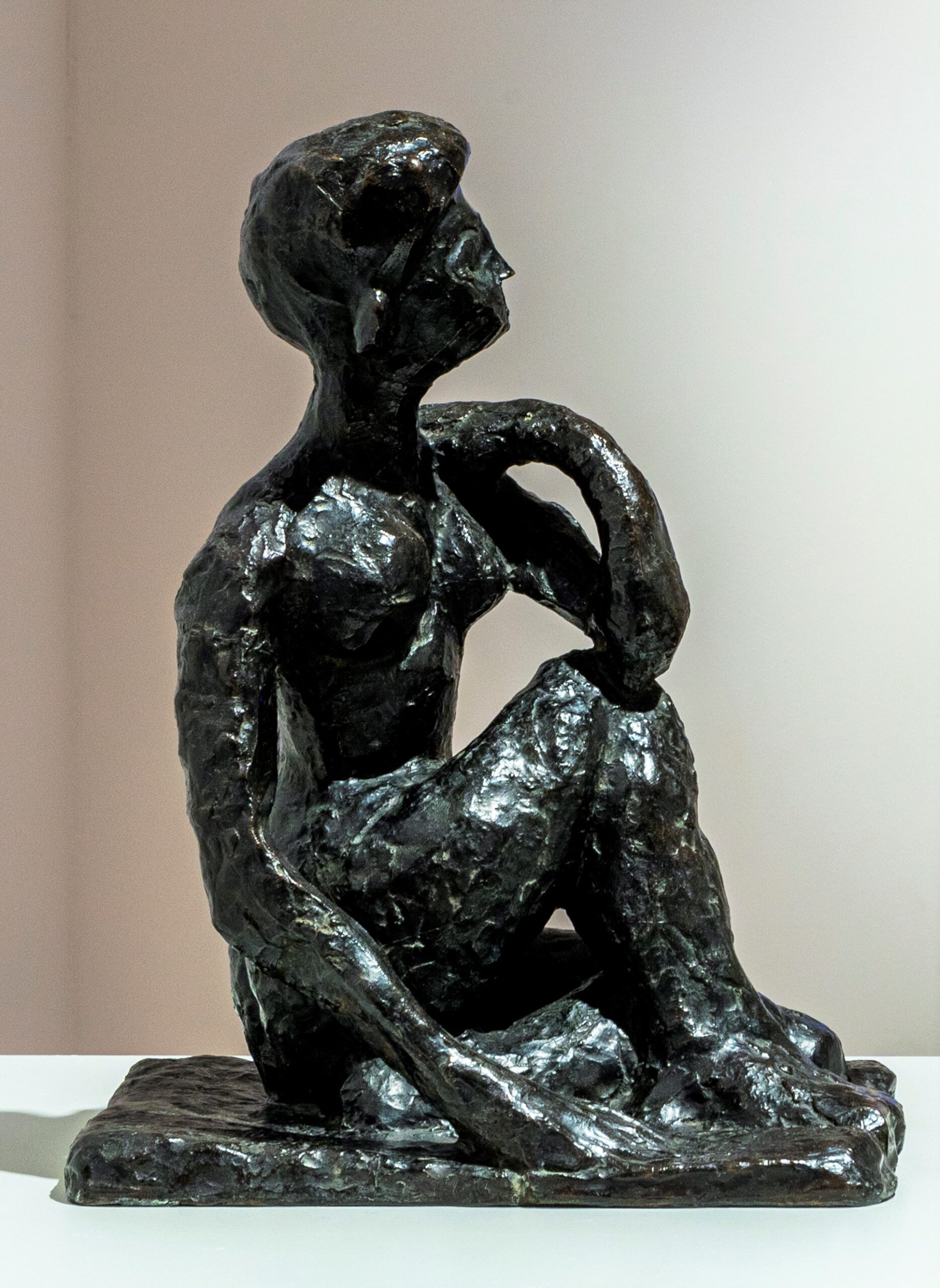
Photograph taken during the exhibition Matisse Métamorphoses
© Succession H. Matisse | Photo © Ville de Nice
© Succession H. Matisse | Photo © François Fernandez