Come and marvel at “Fleurs and fruits”! Following its restoration, the museum space around this masterpiece has been completely redesigned.
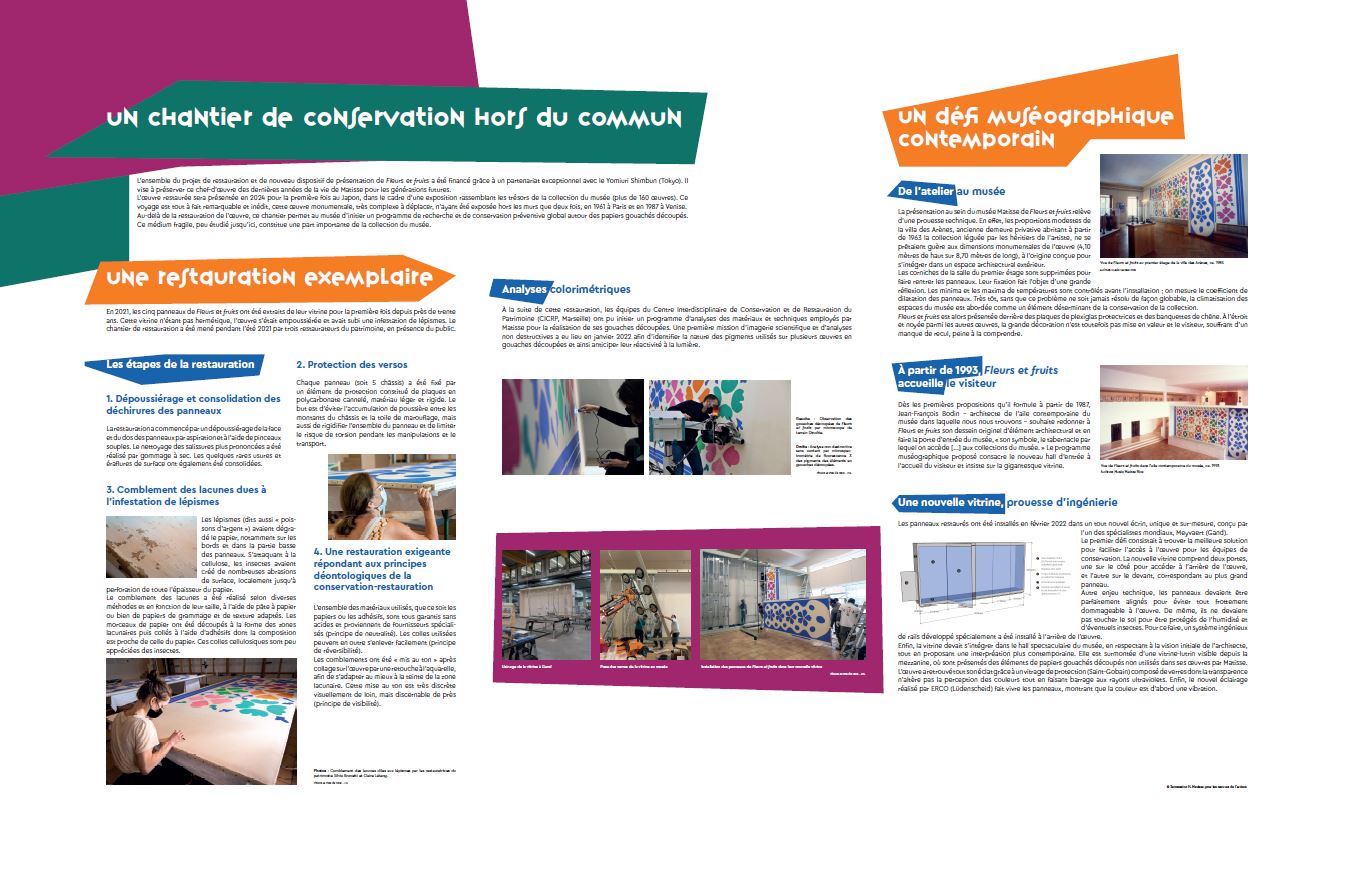
Fleurs et fruits (Flowers and Fruits) is a monumental work (8.70 metres long by 4.10 metres high), created by Henri Matisse towards the end of his life, in 1952-1953, using the paper cut-out technique. Since 1993, it has welcomed visitors to the Matisse Museum in a large entrance hall designed by the architect Jean-François Bodin, project manager of the renovation and extension of the Matisse Museum in the early 1990s.
In 2021-2022, this masterpiece was restored and its old display case was replaced by a new tailor-made version, showing it off to much better effect and ensuring its proper conservation for future generations. At the same time, the museum wanted to reorganise the entire museum space around this work to promote its reception and understanding by all.
A new educational space
For curious visitors who want to learn more, an educational space has been set up near the work, tracing the context of its creation in the Régina studio, its history at the museum, and the progress of its restoration. The public can also discover the stages of the work thanks to a short documentary film.

© Succession H. Matisse for the work by the artist
Photo © François Fernandez
An air of a Californian villa
Since the start of summer 2023, visitors can contemplate Fleurs et fruits while sitting comfortably in sofas and armchairs from the “Malibu” line created in 1950 by American designer William Haines (1900-1973), one of the heights of Modernist design, for the villa of collectors Sidney and Frances Brody in Los Angeles. This new furniture helps evoke the setting for which the work was initially intended. Indeed, Fleurs et fruits is one of four projects developed by the artist to respond to the order (in 1952) for a ceramic decoration for the patio of the Brodys’ Californian villa. Matisse designed the work in connection with the architecture and decoration of the house. The version ultimately selected, La Gerbe (The Sheaf), is now on display at LACMA.
Playing with Fleurs et fruits
The museum has developed with the Mosquito company an innovative touch table which offers a digital puzzle. Young and old can play at reconstructing the work by positioning the cut-out shapes in the right location. This collaborative game invites visitors to actively observe the work and intuitively understand the principle of composition. This is in fact based on the repetition of modules (representing stylised petals, pistils and fruits) of different colours. The modules seem identical at first glance, but if you look closely, you’ll see that they are almost all different. Matisse actually cut directly into the pieces of paper covered with gouache, without drawing the precise contours beforehand.
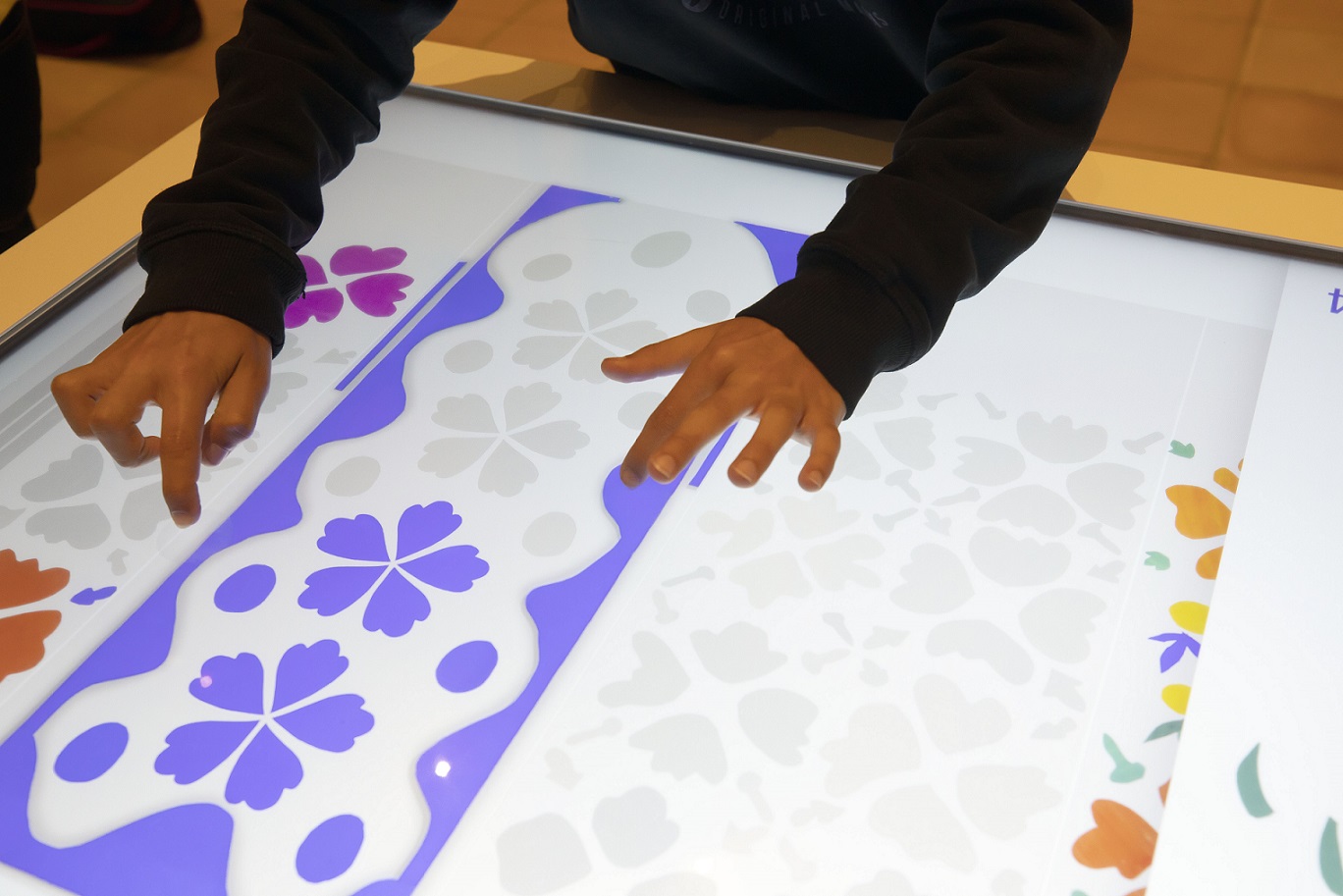
Photo © Ville de Nice – P.S.
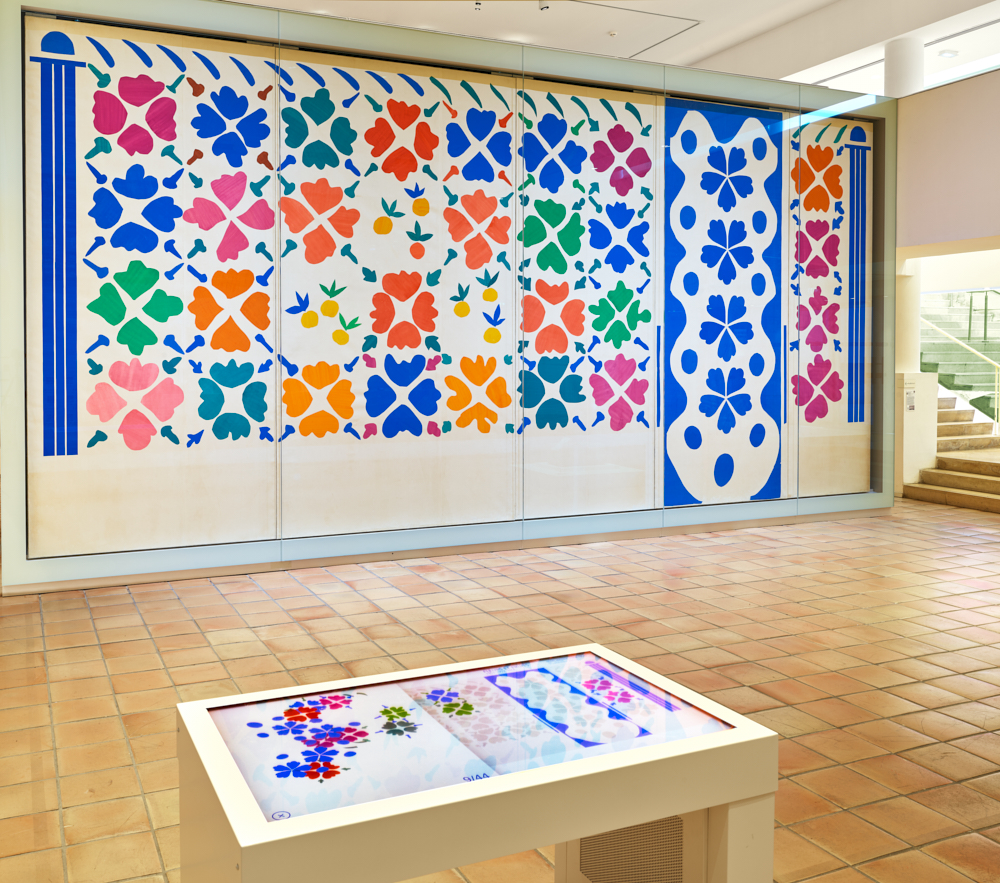
Photo © François Fernandez