With Hélène (or Elena) Galitzine-Mercier (1912, Saratov, Russia – 1966, Solothurn, Switzerland), it’s as much a fantasised incarnation of the Slavic soul as the vector of pictorial change that Matisse was looking for by hiring this Russian princess from January 1936. She had sporadically posed for him at the end of 1935 when he expressed the specific desire to work with a Russian model. Her little sister, Elisaveta, in charge of the care of Claude Duthuit, Matisse’s grandson, had encouraged Hélène to introduce herself to the painter. This is how she came to pose for about twenty paintings and numerous drawings between 1936 and 1939, occupying an important place during those years.
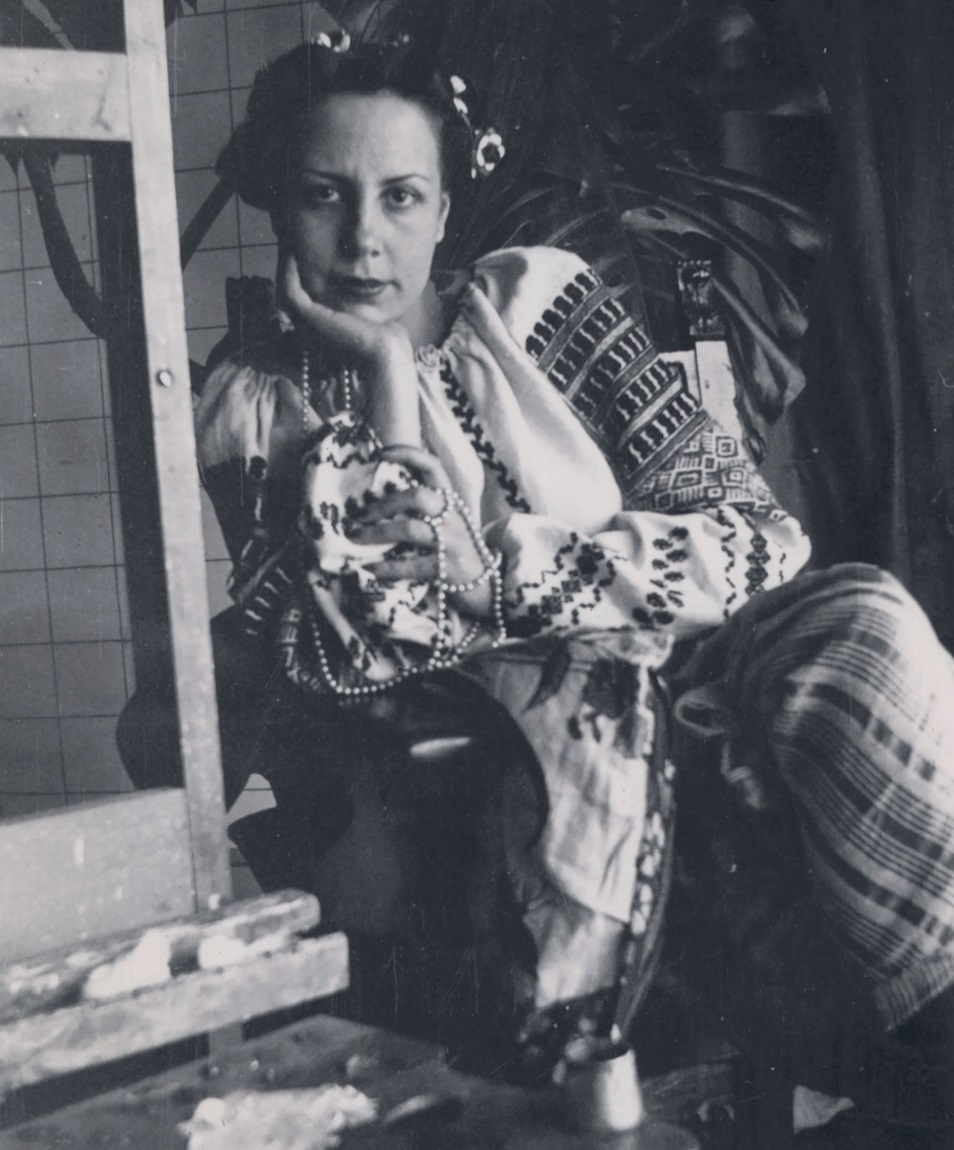
Photograph by Henri Matisse
Photo: Archives Henri Matisse
The tormented fate of Hélène Galitzine-Mercier, inseparably linked to the October Revolution and the exile of the Russian aristocracy that followed, has inspired several books (fictionalised biography by David Brunat, Une princesse modèle and Carnet de souvenirs, written by her daughter, Ella A. Mercier). Her life is therefore well known to us. She knew the fate of many Russian aristocrats exiled after the 1917 revolution, whose lives, thrown into disarray, have frequently become synonymous with precariousness and loss of social position. After her father’s death, she had to flee Russia with her mother and three sisters. They found refuge in Arco in Italy, where Hélène grew up and studied. In 1928, the death of their mother forced the Galitzines to move again: they settled in Nice. Hélène met her first husband there, Alexis Mercier, and started a family. In 1943, she moved to Switzerland where she lived with her second husband until her death in 1966.
The Henri Matisse archives contain a series of photographs documenting a posing session for the making of La Blouse roumaine aux manches vertes (1937, Cincinnati Art Museum) →
Matisse had set up a small room full of clothes and fabrics where the models were invited to go for fittings until he was satisfied and began the posing session. According to the paintings, Matisse dressed Hélène’s elegant silhouette in a purple bolero, Ottoman or Persian tunics, Romanian blouses and even haute couture dresses.
Working in Nice for the Violette Henry fashion house, Hélène perhaps shared with the painter this pleasure in clothes and fabrics.
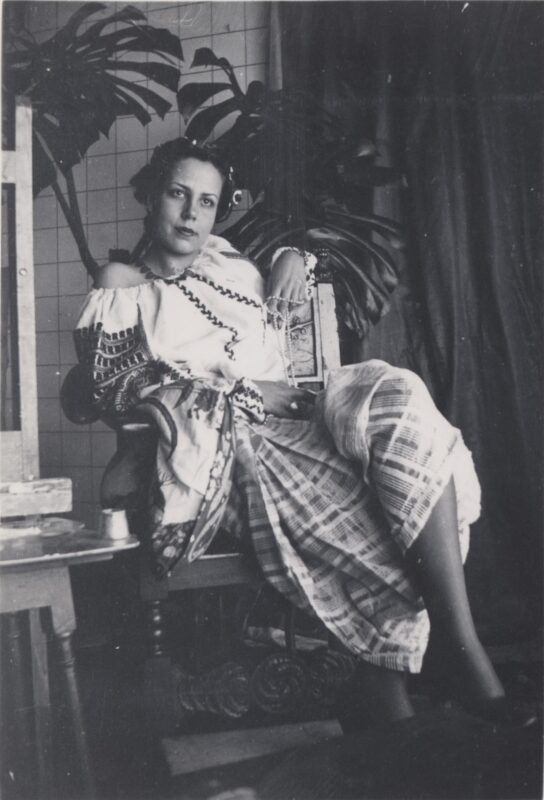
Photo: Archives Henri Matisse
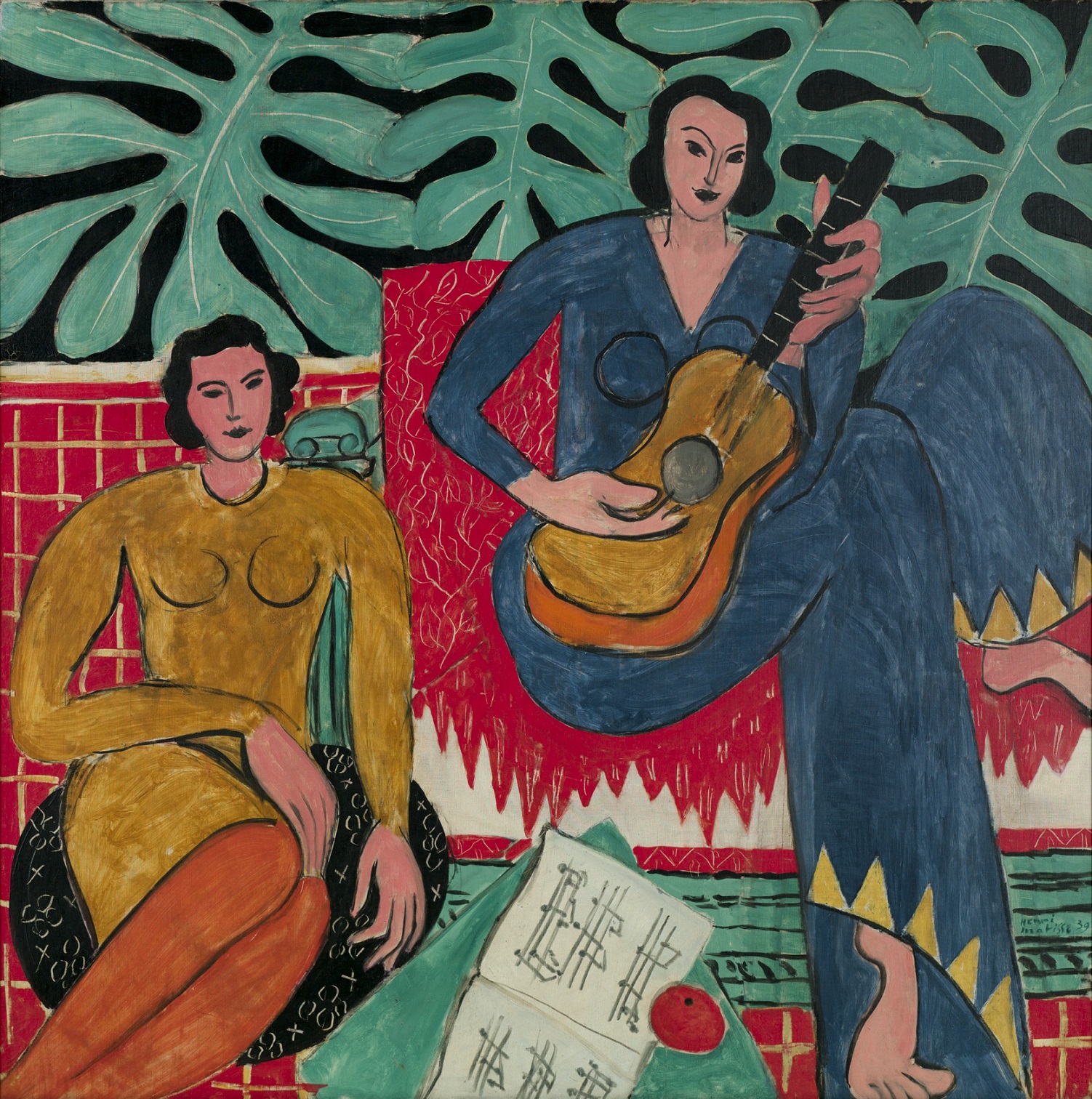
© Succession H. Matisse | Photo © Brenda Bieger, Buffalo AKG Art Museum
In La Musique, Hélène stands, guitar in hand, next to her cousin, Natasha Boulgakova. Playing on the chromatic accords and echoes between the motifs (the green of the philodendron placed behind the two women has spread to a coffee table and the bench where Hélène is seated, while the same red strikes a chord with the fabric covering this piece of furniture, the tiled wall of the room and an apple), Matisse brings musicality to this painting, diversifying the experience we have of it. The open score and musical instrument invite us to watch as much as “listen” to the harmony that emanates from it.
Hélène in the work of Matisse
Since he worked, between 1930 and 1933, on the wall decoration project for the hall of the Barnes Foundation in Merion, near Philadelphia, Matisse continued ceaselessly to reconcile painting and architecture to go beyond the two-dimensional limits of the painting. This research is clearly reflected in the large-format canvas La Musique (1939, Buffalo AKG Art Museum), as well as in a large fireplace decoration commissioned by Nelson Rockefeller for his apartment in New York, Le Chant (1938, Lewis Collection, Museum of Fine Arts, Houston), as well as in a series of other smaller works. This architectural dimension manifests itself in the way Hélène’s body grows in certain portraits, or in the decorative expansion of the motifs (plants, squares, stripes, etc.) with which he sprinkled the entire surface of his compositions. Hélène’s clothes take on as much importance as she does and are often an opportunity to deploy patterns that give the impression of extending beyond the frame of the canvas.
Hélène through a work from the collection :
Deux figures assises au fauteuil natté, ca. 1937-1938, study for La Conversation (1938, San Francisco Museum of Modern Art)
In several paintings from the late 1930s, Hélène posed alongside Lydia Delectorskaya. An impression of intimacy and serenity characterises these paintings. The tormented destiny of these two Russians undoubtedly brought them closer, and they forged a friendship over the posing sessions. By dressing his models in haute couture dresses without sometimes rendering the features of their faces (as in La Conversation, 1938, private collection), Matisse attached less importance to their individuality than to their femininity. Their stylised bodies become simple signs, signs of presence and chic.
The singularity of Lydia’s features (on the left) and Hélène’s (on the right) nevertheless appears in La Conversation, whose tight frame accentuates the intimacy between the two women. A preparatory drawing belonging to the museum’s collection underlines this proximity, the rapid pen drawing establishing a continuity between them: folds of the dresses and uncertain borders of the bodies unite them without contradicting the differences in their features and hairstyles, reinforced by the disparate style of their armchairs. But more than the individuality of each, Matisse focuses on the friendship that binds them.
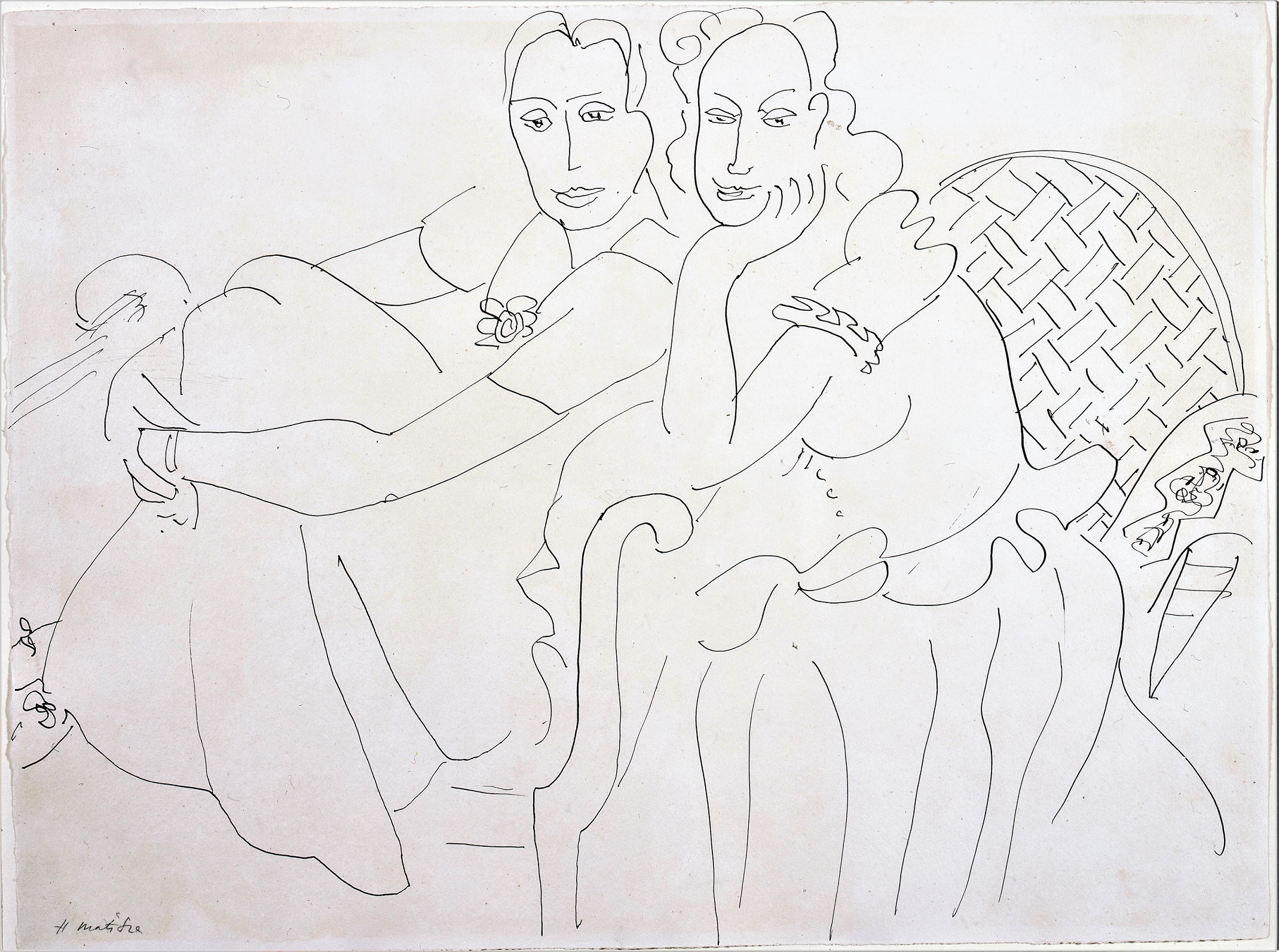
© Succession H. Matisse | Photo © Ville de Nice

© Succession H. Matisse | Photo © SFMOMA, Ben Blackwell