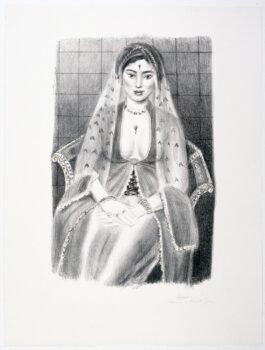
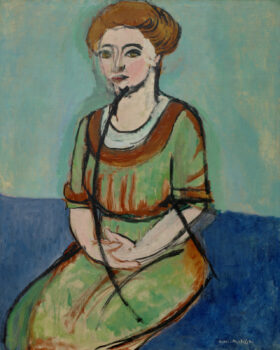
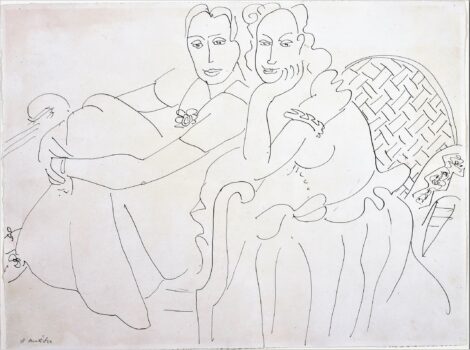
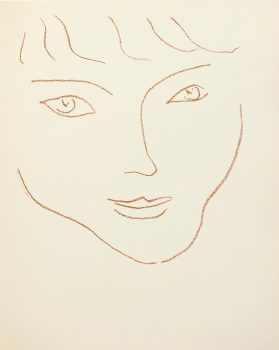
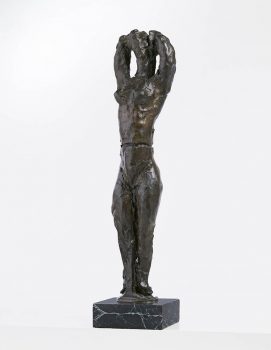
The musée Matisse is launching a research project on around forty models with whom Henri Matisse worked throughout his life.
The model, for others, means information. For me, it’s something that stops me in my tracks. It’s the focus of my energy.
Henri Matisse, quoted by Louis Aragon in “Matisse-en-France”, Matisse, Roman, Gallimard, 1998 [1971], p. 110
Until 1916, Matisse mainly had members of his family pose, his wife Amélie or his daughter Marguerite in particular, plus a few occasional models. He then established special, intense working relationships with some of the models, to the point that entire periods of his work are associated with a single woman: Laurette in 1916-1917, Henriette in the 1920s or Lydia in the 1930s, for example.
Though ever-present in his work and decisive during the creative process, these women have often been overlooked. Apart from a few photographs and a surname, or even sometimes just a first name, only the trace of the poses they held for hours remain, their appearance, sometimes anonymous, in paintings, drawings and sculptures by Matisse.
To address these gaps in our knowledge, let’s take a proper look at each of them. It’s a question of focusing on them, one by one, in all their individuality to better understand their role and what specifically their body and their personality could bring to Matisse’s creative work.
In Matisse’s interior laboratory, the posing session had a fundamental function. It was almost like a trance, the artist not trying to “draw or paint the external resemblance, but rather [to] establish communication of a psychic nature with the model”1. Matisse needed the physical proximity of the model to surrender to her presence. She became consubstantial with him to the point that he identified with the woman he was capturing. Didn’t he say himself that he worked “very close to the model – within himself – with his eyes less than a metre from the model and his knees possibly touching hers”2?
Mention has often been made, when truncating the quotation, of his “desire to keep himself in a state of a kind of flirtation which ends up culminating in rape3”. Undeniable violence, but which we forget was exercised with regard to himself. Omitting the question he then asks – “whose rape? A rape of myself, of a certain tenderness or weakening in face of a sympathetic object” – we miss a central aspect of this daily face-to-face. During the course of the sitting, the model “is by convention completely available”, and exhaustion also awaits some subjected to nervous tension and a sustained work pace4. The session, fixed every day at the same time, followed a very specific ritual. The models, once paid, followed Matisse’s instructions: choice of pose, use of accessories, hairstyle, degree of nudity or selection of clothing. But a reciprocity was established, the artist assuming a “state of total receptivity vis-à-vis his model5”.
To question Matisse on his models also means understanding his dependence on them and giving them their rightful place, less that of “muses” but rather catalysts of his creative energy, of women-forms who fascinated him and whom he couldn’t do without.
- Claudine Grammont, Matisse & Picasso, La comédie du modèle, Liénart, 2018, p. 16.
- Henri Matisse quoted by Louis Aragon in « Matisse-en-France », Matisse, roman, Gallimard, 1998 [1971], p. 132.
- Henri Matisse quoted by Louis Aragon in « La Grande songerie », Matisse, roman, Gallimard, 1998 [1971], p. 293.
- Isabelle Monod-Fontaine, « La séance de pose », Henri Matisse, le laboratoire intérieur, Hazan/Musée des Beaux-Arts de Lyon, 2016, p. 153 ?
- Claudine Grammont, Matisse & Picasso, La comédie du modèle, Liénart, 2018, p. 17.

Photograph by Marguerite Matisse
Photo : Archives Henri Matisse